GEO Agency vs SEO Agency: Which Does Your Business Need?
GEO agencies optimize for AI answers; SEO agencies optimize for Google rankings. Here's how the two differ, where they overlap, and which one your business should hire.
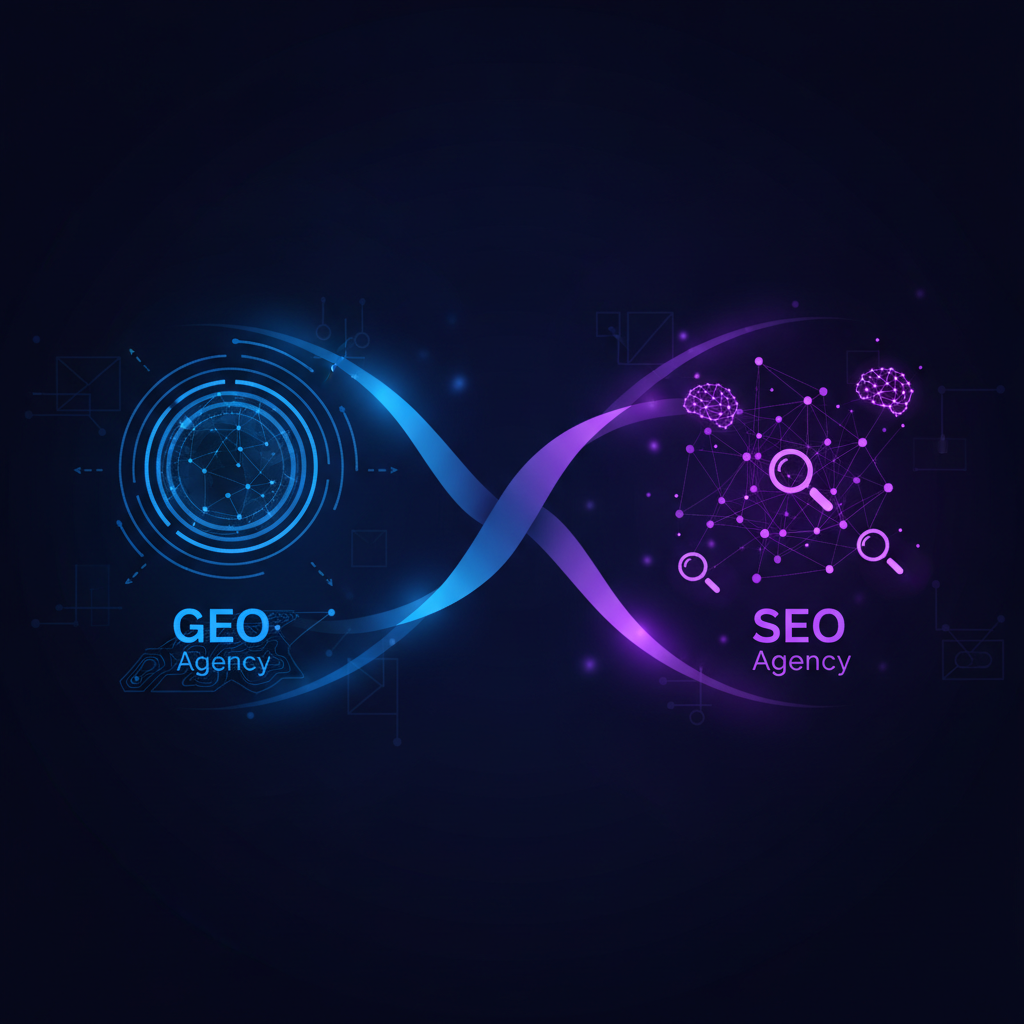
A GEO agency works to get your business named and cited inside AI answers from ChatGPT, Claude, Perplexity, and Google’s AI Overviews, while a traditional SEO agency works to rank your pages in Google’s blue links. Most businesses in 2026 need both, because buyers now start in both places — and the gap between the two disciplines is wider than the shared “search” label suggests.
That shift is not speculative. SparkToro’s 2026 analysis found that less than one-third of Google searches now send a click to the open web. When the answer is delivered on the results page or inside an assistant, ranking first is worth less than being the source the answer is built from. This guide breaks down what each type of agency actually does, where they overlap, and how to decide which to hire first.
What is the difference between a GEO agency and an SEO agency?
An SEO agency optimizes for position in a list of links; a GEO agency optimizes for inclusion in a generated answer. Generative Engine Optimization (GEO) is the practice of making your content, entities, and reputation the material that large language models pull from when they answer a question — a different target than climbing Google’s organic results.
The mechanics diverge because the systems reward different things. A traditional SEO program leans on keywords, backlinks, and technical health to move a page up the rankings. A GEO program leans on evidence density, entity clarity, and third-party consensus, because that is what a language model uses to decide whom to name. Princeton’s “Generative Engine Optimization” study (Aggarwal et al., 2024) found that adding statistics, citations, and direct quotations to a page raised its visibility in AI-generated answers by up to roughly 40% — levers that have little to do with where that page ranks in Google. An agency built only for the old game can miss the new one entirely.
The cleanest way to think about it: SEO asks “how do we rank this page?” while GEO asks “how do we become the answer?” The first is about a position you occupy; the second is about a sentence a model writes. Both still matter, but they are increasingly separate jobs that need separate measurement.
Do you need a GEO agency, an SEO agency, or both?
Most businesses need both functions, but the right starting point depends on where your buyers already are and where you are already losing. If you rank well in Google but never get named by AI assistants, GEO is the gap. If you are invisible in both, the foundations of SEO usually have to come first.
The two are not interchangeable, and they are not in conflict. Solid SEO fundamentals — a crawlable site, clear information architecture, authoritative content — are also what make a page legible to an AI model, so the disciplines reinforce each other. The difference is in the final mile: SEO stops at the ranking, while GEO continues into how the answer gets assembled and whether your reviews, mentions, and structured data earn you a place in it. The table below maps where they split.
| Dimension | SEO agency | GEO agency |
|---|---|---|
| Primary goal | Rank pages in Google’s organic results | Get cited and named inside AI answers |
| Main targets | Blue links, featured snippets, map pack | ChatGPT, Claude, Perplexity, AI Overviews |
| Core levers | Keywords, backlinks, technical SEO | Evidence density, entities, reviews, consensus |
| Success metric | Rankings, organic traffic | Citation share, AI mentions, AI-referral sessions |
| Time to results | 3–6 months | Often 4–8 weeks for first citations |
For a local service business, the practical answer is usually “both, run as one program,” because the same review velocity and consistent listings feed Google and the AI engines together. For a B2B company whose buyers already research vendors through ChatGPT, GEO may be the more urgent investment. The decision is less about choosing a camp and more about sequencing the work to fix your biggest leak first.
What does a GEO agency actually do that a traditional SEO agency doesn’t?
A GEO agency tracks AI citations, engineers answer-shaped content, builds entity and reputation signals, and earns third-party mentions — work that sits outside a classic SEO scope. These are the inputs that decide whether a model trusts and quotes you, and they are measured against AI answers rather than search rankings.
Citation tracking is the clearest example. A traditional SEO dashboard shows keyword positions; a GEO program runs a fixed set of buyer-intent prompts across assistants on a schedule and records who gets named, who gets linked, and which questions you win or lose. That data drives a content roadmap aimed at being quotable, not just rankable. The on-page work shifts too: a front-loaded direct answer, a specific statistic, and a sentence a model can lift verbatim do more for citation odds than another round of keyword tuning.
The off-site work is where the divergence is starkest. AI models lean heavily on third-party consensus — reviews, directories, roundups, and community discussion — when deciding whom to recommend. Research from Trustpilot, reported by TechRadar Pro (2026), found businesses with 80 or more reviews were cited in over 75% of AI answers, while businesses with no reviews appeared in roughly 1%. A GEO agency treats review velocity and brand mentions as core deliverables; a traditional SEO agency often treats them as someone else’s department.
How do you know if your current SEO agency is keeping up with AI search?
Ask your agency to show you where you appear in AI answers today — if they can only talk about rankings and traffic, they are optimizing for a shrinking slice of how buyers actually search. The honest tell is whether they measure AI visibility at all, not whether they use the right buzzwords.
A few questions surface the gap quickly. Ask which buyer prompts they test in ChatGPT and Perplexity, and how often. Ask how they would get you cited for a question where the current answer names a competitor. Ask what they do about reviews and off-site mentions, not just on-page changes. Vague answers — “we optimize for AI” with no specifics, or a pivot back to keyword reports — usually mean the AI work is a label, not a practice. The discipline is new enough that plenty of agencies have added “AI” to their pitch without changing what they do on Monday morning.
The point is not to fire a competent SEO partner. Strong rankings still drive real traffic and still help models find you. The point is to know whether anyone is accountable for the AI channel, because if no one is, you are likely already losing recommendations you can’t see. When we ran our own informal test in June 2026 and asked ChatGPT to recommend the best AI visibility agencies, it named roughly a dozen firms — a useful reminder that being absent from these answers is the default, not the exception.
What does hiring a GEO or SEO agency cost, and how fast does it work?
Pricing varies widely by scope, but the bigger difference is timeline: AI citations often move within weeks, while Google rankings typically take months. Both are ongoing disciplines, not one-time projects, because the engines and the competitive set keep changing underneath you.
On speed, the two channels behave differently. AI models refresh their retrieval and source weighting frequently, so a well-structured page and a few earned mentions can start showing up in answers within four to eight weeks. Traditional ranking gains usually take three to six months to consolidate, because Google’s evaluation is slower and more authority-dependent. That difference is one reason GEO can feel like the faster win for a business that already has decent content but no AI presence — there is often low-hanging fruit a model can pick up quickly.
On cost, beware of two failure modes regardless of which agency you hire. The first is guaranteed results: no agency controls what a model says, so promises of “guaranteed ChatGPT placement” are a red flag. The second is one-time optimization: a single audit does not hold, because AI citations turn over constantly and competitors keep publishing. What you actually want is a program with clear measurement, a content and reputation roadmap, and accountability for both rankings and AI citations over time. If you want to compare doing this in-house versus handing it off, our breakdown of AI citation tracking tools vs. done-for-you walks through the trade-offs, and the 2026 AI visibility agency buyer’s guide covers what to ask before you sign.
What we’d actually do
If we were choosing today, we would stop framing it as GEO versus SEO and start treating AI visibility and rankings as one program with two scoreboards. We would fix the SEO foundations that make a site legible to both Google and a language model, then layer GEO on top: track the buyer prompts that map to revenue, restructure the pages where we nearly get cited, and earn the reviews and mentions that move us into the answer. The order depends on your biggest leak — but the mistake is hiring for only one when your buyers are clearly using both.
The hardest part is simply knowing where you stand, because the AI channel is invisible from a normal analytics dashboard. If you want to see it, book a call and we will run your buyer queries across the major assistants, show you who is getting cited instead of you, and map the shortest path — GEO, SEO, or both — to getting your business into those answers. You can also see how the pieces fit together across our AI SEO, AEO, and GEO services.
Tagged
Get your free website visibility audit
SEO, AI visibility, and Google Business Profile — scored in minutes. Free, no credit card.